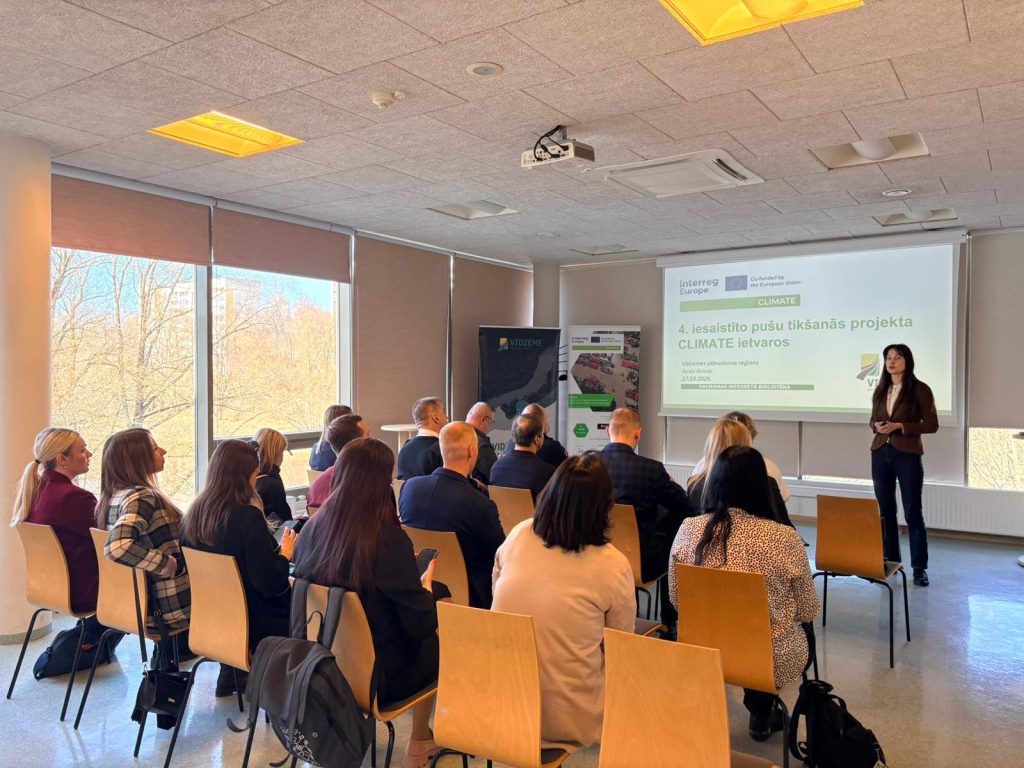
To strengthen societal resilience in the Vidzeme region and promote public involvement in reducing and preventing climate risks, the Vidzeme Planning Region organised the 4th regional stakeholder meeting of the CLIMATE project, titled “Strengthening societal resilience and engagement for climate risk reduction in the Vidzeme region”.
During the event, it was emphasised that societal resilience and active public involvement in crisis situations are among the most important preconditions for effective crisis management. Experts shared experiences and practical examples that help strengthen the ability of local communities to act in the face of various threats.
Speaking about mechanisms for public engagement in climate governance, the head of the Valmiera Region Community Foundation, Patricija Siliņa, introduced the experience of Brussels. There, a structured volunteer system is being developed, which provides for the involvement of residents in crisis management also at an individual level. Volunteers are trained and prepared to act in a coordinated and effective manner during emergencies. This approach helps prevent situations where spontaneous, albeit well-intentioned, assistance may interfere with the work of professional services.
At the same time, it was emphasised that a volunteer system cannot replace professional services – strong public safety and rescue services are a fundamental basis for effective crisis management.
Undīne Blumberga-Šakuna, an expert on civil society and community development at the Valmiera Region Community Foundation, introduced the programme “Safe Communities in Vidzeme”. Its aim is to strengthen the capacity of local communities to self-organise, cooperate, and participate, while promoting an understanding of the common good and responsibility towards others, as well as developing societal resilience skills.
Within the programme, several activities are planned:
· to promote the formation of new neighbourhood communities and the involvement of residents in community development;
· to identify and train motivated residents who, in crisis situations, would be able to coordinate spontaneous volunteers in cooperation with municipalities;
· to strengthen cooperation among residents, creating cohesive and resilient communities and a safer living environment.
Communities will also have access to funding for the implementation of local initiatives.
Particularly valuable for participants was the experience shared by Gunta Bazone, an expert from the Response Management Division of the Civil Protection Administration of
the Riga City Council. She shared practical examples of establishing and organising evacuation points in Riga, as well as outlined research results on public preparedness for crisis situations. The findings indicate that although residents are interested in safety issues, practical preparedness remains insufficient – many do not know where the nearest shelters are located or how to act in emergency situations.
Seminars organised in Riga, titled “Riga Civil Protection Plan – Know It and Get Involved”, were also highlighted, where residents can obtain detailed information on actions in crisis situations – from evacuation to shelter locations.
At the end of the meeting, participants worked in groups to develop an action plan for flood situations. Crisis scenarios were modelled, focusing on public preparedness, information flow and communication, evacuation, the involvement of NGOs and volunteers, as well as institutional cooperation. Using the backcasting method, participants defined concrete steps to be taken today to ensure effective crisis management in the future.
The event also provided an opportunity to exchange up-to-date information on planned activities of organisations aimed at strengthening societal resilience and engagement in the Vidzeme region.
This publication has been prepared with the financial support of the European Union. The content of this publication is the sole responsibility of the Vidzeme Planning Region and does not necessarily reflect the views of the European Union.
The project “Improving EU regions’ environmental and socioeconomic resilience to climate change” (CLIMATE) is being implemented under the Interreg Europe cross-border cooperation programme from 2021 to 2027. It aims to support participating regions in strengthening their ability to adapt to the impacts of climate change by improving disaster risk prevention, enhancing civil protection capacities, and fostering inclusive, cross-sectoral cooperation.


